Textile production on the gourmet farm
Textile production on the gourmet farm links three buildings, the dye factory, the spinning factory and the clothing factory, into a single chain that turns cotton, flax, wool and silk into finished clothes and accessories. The plant-based resources you grow in the garden, the animal ones come from the sheep pen and the rabbit hutch, dyes are made from vegetables, and only by combining fine textiles with dyes do you get the final piece of clothing. None of the three buildings works on its own, so it pays to plan the supply of resources for all three at once.
Textile production is worth it as soon as your gourmet farm is at least level 19 and you have a steady supply of cotton, flax and wool. Because of the high resource consumption of wool and the long road to the maximum building level (farm level 142), though, it is more of a chain you build up gradually than a quick earner.
Textile resources grow in the garden and come from your animals
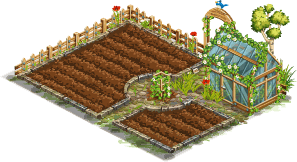
You grow cotton from cotton seeds sown in the garden of the gourmet farm, or as an edge plant right on the meadows. If you do not want to wait for the harvest, cotton can also be bought outright for gold, which comes in handy when you run out of stock in the middle of production.
Flax grows in the garden of the gourmet farm just the same, and the harvest also gives you flax seeds. The flax itself is then processed in the spinning factory into fine linen or linen thread. On top of that, both crops have special cotton seeds and special flax seeds, which are grown in the nursery and have a different growth speed and yield than the regular seeds.
The second group of resources is animal fibers. Raw wool comes from the sheep pen, angora wool from the rabbit hutch. For the spinning factory you will also need silk as another input resource for fine silk.
Three factories on the gourmet farm form one production chain
Textile production rests on three buildings you will only find on the gourmet farm, namely the dye factory, the spinning factory and the clothing factory. All three share the same basic stats, which helps when planning space and workers.
| Level 1 | Maximum, level 8 | |
|---|---|---|
| Price | 10 000 Dollars | 7 000 000 Dollars |
| Construction time | 30 minutes | 2 days 17 hours |
| Number of workers | 4 | 52 |
All three buildings measure 7×6 tiles and unlock at level 19 of the gourmet farm. You can only upgrade them to the maximum eighth level once you reach farm level 142, so this is a long-term project better suited to a more developed farm.
The dye factory turns vegetables into primary and secondary dyes
| Resource | Dye | Production time |
|---|---|---|
| Beetroot x10 | Red dye x5 | 15 minutes |
| Red cabbage x20 | Blue dye x5 | 45 minutes |
| Onions x15 | Yellow dye x5 | 22 minutes |
| Beetroot x10 + Onions x15 | Orange dye x5 | 15 minutes |
| Beetroot x10 + Red cabbage x20 | Purple dye x5 | 45 minutes |
| Onions x15 + Red cabbage x10 | Green dye x5 | 22 minutes |
The pattern is easy to remember. Beetroot gives red, cabbage blue and onions yellow, and the secondary colors come from combining two of the basic resources. Dyes are a universal material that you then put to use in the clothing factory for every colored piece of clothing.
The spinning factory refines cotton, flax, wool and silk
| Resource | Product | Production time |
|---|---|---|
| Cotton x10 | Fine cotton x5 | 15 minutes |
| Raw wool x250 | Fine wool x5 | 45 minutes |
| Silk x15 | Fine silk x5 | 22 minutes |
| Flax x10 | Fine linen x5 | 1 hour 15 minutes |
| Flax x10 | Linen thread x5 | 2 hours |
| Angora wool x250 | Fine angora wool x5 | 45 minutes |
What jumps out the most is the difference in wool consumption compared to the other resources. A single batch of fine wool or fine angora wool takes 250 units of the resource, while cotton, silk and flax only need a few dozen. Before you set the spinning factory to produce woolen products, make sure you have enough stock in the sheep pen or the rabbit hutch, otherwise production will grind to a halt for want of resources. Flax also gives you two different products, fine linen or linen thread, depending on what you need next in the clothing factory.
The clothing factory combines fine textiles with dyes into finished pieces
| Resources | Product | Production time |
|---|---|---|
| Fine cotton x10 + Blue dye x10 | Blue jeans x5 | 15 minutes |
| Fine silk x10 + Red dye x10 | Red silk dress x5 | 15 minutes |
| Fine wool x10 + Yellow dye x10 | Yellow wool scarf x5 | 15 minutes |
| Fine linen x5 + Feathers x10 + Orange dye x10 | Orange pillow x5 | 15 minutes |
| Fine cotton x5 + Fine wool x5 + Green dye x10 | Green winter jacket x5 | 15 minutes |
| Fine silk x5 + Fine linen x5 + Purple dye x10 | Purple summer skirt x5 | 15 minutes |
Every recipe in the clothing factory takes the same 15 minutes, so what sets the pace here is not the sewing itself but how quickly you can restock fine textiles from the spinning factory and dyes from the dye factory. Three recipes only need one fine textile and one dye, another three combine two resources and the orange pillow even needs three, so it pays to keep a broader range of materials in stock rather than focusing on a single product.
Buildings and products mentioned in the text
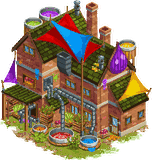 Dye factoryGourmet farm · from level 19 · 7 × 6
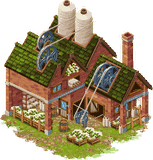 Spinning factoryGourmet farm · from level 19 · 7 × 6
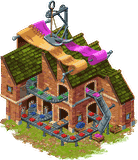 Clothing factoryGourmet farm · from level 19 · 7 × 6
 CottonBasic product · Flower farm
 Fine linenProcessed product · Gourmet farm
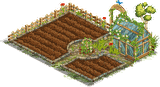 GardenGourmet farm · from level 19 · 9 × 7
 Angora woolBasic product · Gourmet farm
 Fine woolProcessed product · Gourmet farm