How to earn dollars on your farm
You need dollars on the farm for absolutely everything, from putting up buildings through making feed to expanding your land, and yet where they come from is fairly clear. Here I will show you where dollars really come from, what is worth selling right away and what to keep for processing, and how to cut your production costs to a minimum through your workers' happiness.
Where the dollars on your farm come from
The game runs two currencies side by side. Gold is the premium currency for special buildings, decorations and speed-ups, while dollars are your operating money, the cash you pay with for almost everything in the Build and Farm management menus, including production costs.
You earn dollars above all by selling your products and as a reward for completing tasks. In practice that means three main sources of income.
- Selling the crops you grow and the products you process in the Farm management window.
- Completing customer contracts in the market hall.
- Rewards for finished missions and other tasks around the farm.
What to sell right away and what to keep for processing

Besides the field crops you plant, your farm also gives you secondary products. You collect eggs in chicken coops, milk in cowsheds and pigs in pigsties, and apples or cherries from the matching orchards. On the gourmet farm you add goat milk from the goat stable and almonds from the almond orchard.
You can either sell these products straight away or use them as ingredients to make something else. The main thing to watch is what the customers in the market hall want right now and what the contracts are asking for, because customers keep an eye on what you produce on your farms and adjust their demands to match. Raw goods nobody is asking for are better turned into a finished product, since that can be sold or delivered into a contract later for more.
Customer contracts as your main source of income
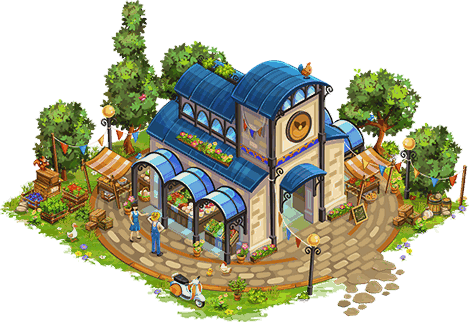
The most reliable way to dollars is customer contracts in the market hall. You normally have up to six contracts available at once and each one can ask for one to six different products. You can add products to a contract one at a time or all at once, and as soon as a contract is complete you deliver it with a single click on the delivery button, or send several at once by truck.
The faster you fill an order, the more dollars you get, and if you complete a contract asking for the same products several times in a row, the value of the contract grows and the reward for finishing it is higher. You only get paid once the truck has made the delivery, and the payment can come in different currencies, including dollars, experience points or horseshoes. Every now and then a trader turns up in front of the market hall with a special offer of products, tokens and fertilizer, and it is worth taking a look.
Missions and reputation points as a side income
Missions are contests against other players that you can jump into at any time and that last 30 minutes. You get a randomly assigned task, for example harvesting as much of a specific crop as possible or producing as many goods as you can, and the better your result compared to your rivals, the bigger the reward at the end.
Finishing a mission successfully earns you reputation points and certificates, which you need to build and upgrade farming machines and for the cooperative competition, and the reward usually includes other resources as well. If you start another mission shortly after finishing the previous one, you also get bonus reputation points, so it pays to chain missions one after another instead of waiting around between them.
How happiness lowers your production costs
Every time you start production in a production or processing building you pay a certain amount of dollars as production costs. That amount is not fixed, though, because it depends on the happiness on that farm, and perfect happiness can bring your production costs down to zero.
Your workers' happiness depends on how many houses and decorations you have on that particular farm, and every farm has its own happiness level calculated separately. Decorations are not just eye candy then, they are a direct investment in lower running costs and therefore in a bigger net profit from your sales and contracts.
Which decorations are worth building
When picking decorations it pays to look at the ratio of happiness to the number of tiles they take up, because that ratio is what decides how good a decoration really is. Small, cheap pieces are the way to go at the start, while the bigger and pricier ones belong on farms where you already have room to spare and want to cut costs more seriously.
- Pumpkin wheelbarrow (4x3, happiness 72, price 1 gold) is a dirt cheap way to get happiness going quickly on a new farm.
- Hawaiian garden (6x4, happiness 72, price 5950 gold) and Nostalgic carousel (5x5, happiness 76, price 6500 gold) give a decent happiness to space ratio for a reasonable price.
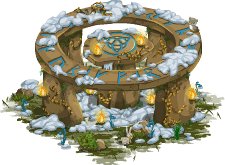
- Rune circle and Oasis of idleness (both 7x7, happiness 150) cost more, but they take up fewer tiles per point of happiness than the small cheap decorations, so they come in handy once your farm is packed and space is your problem.
- Azure temple (6x6, happiness 171, price 30000 gold) is one of the strongest happiness decorations in the game, but the price means it only makes sense later on.
Buildings and products mentioned in the text
 Market hallMain farm · 1 × 1
 Almond orchardGourmet farm · from level 24 · 7 × 7
 Chicken coopMain farm · 5 × 5
 Goat stableGourmet farm · from level 19 · 6 × 6
 CowshedMain farm · from level 13 · 8 × 5
 GardenGourmet farm · from level 19 · 9 × 7
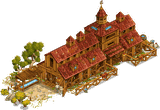 StableHorse ranch · from level 15 · 4 × 14
 FieldMain farm · 8 × 6
Back to Guides.