Mills and feed production
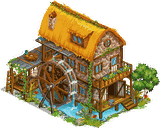
The mill is the building almost every crop from your fields passes through before it ends up as feed in your animal buildings. On the main farm that's the windmill, on the gourmet farm the water mill, and both do the same job - they take one raw material and turn it into a specific feed for a specific animal. Without a mill your animal production simply stops, because you don't feed chickens, pigs, cows or ducks straight from the grain in the field.
The mill is a mandatory building, your animal buildings won't run without it, and it's worth upgrading ahead of most other things - cutting production from hours down to tens of minutes at max level is far more noticeable than with almost any other building.
The mill turns field crops into feed for each animal building

Processing is the mechanic where one product is turned into another one inside a certain building - on the main farm that means feed, fertilizer or humus. The mill is the first step of that chain for your livestock, turning corn, cabbage, wheat, turnips and alfalfa into the matching feed for each animal building.
You start a production run as soon as you have enough of the raw material in storage, and you also have to account for the production costs of the batch. The more you upgrade the mill, the more feed it makes at once and the shorter the production time.
The windmill on the main farm handles five recipes
The windmill measures 6x4 tiles and you can build it right from the start of the game for 50 Dollars, construction takes 30 minutes and it ties up 4 workers. At level 1 it offers these recipes.
| Crop | Feed | Production time |
| Wheat x82 | Cow feed x10 | 2h 15m |
| Cabbage x60 | Pig feed x10 | 25m |
| Corn x30 | Chicken feed x10 | 6m |
| Turnips x48 | Pig swill x10 | 2m |
| Alfalfa x130 | Cow silage x10 | 4m |
Next to the classic windmill there is also the efficient windmill with the same size and the same recipes, but you buy it for 2500 Gold instead of Dollars. Upgrading that one to maximum costs 100000 Diamonds with a build time of 3 days 8 hours, while the classic mill at max level costs 50000 Diamonds and takes 5 days to build.
The water mill on the gourmet farm processes different raw materials
The water mill stands on the gourmet farm, measures 8x6 and unlocks at player level 19. You found it for 10000 Dollars, construction takes 30 minutes and it ties up 4 workers. The level 1 recipes are these.
| Raw materials | Feed | Production time |
| Lamb's lettuce x124 | Duck feed x10 | 2h 40m |
| Barley x113 | Donkey feed x10 | 2h 30m |
| Dandelion x38 | Goat feed x10 | 25m |
| Parsnips x30 | Rabbit feed x10 | 25m |
| Barley x130 | Quick rabbit feed x10 | 4m |
| Dandelion x50, Almonds x80, Milk x65 | Pellet feed x250 | 1h |
That last recipe is the only one combining three raw materials at once, so you need to stock up on dandelion, almonds and milk in advance.
Upgrading the mill cuts production times dramatically
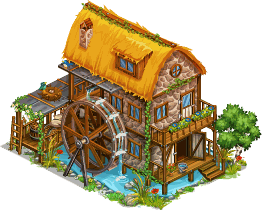
The gap between level 1 and max level is huge. On the windmill the wheat into cow feed recipe drops from 2 hours 15 minutes to just 27 minutes, and wheat consumption falls from 82 to 58. At the maximum tenth level the mill needs 50000 Diamonds, a 5 day build and 60 workers, and it requires player level 124.
It works the same way on the water mill, where duck feed production drops from 2 hours 40 minutes to 27 minutes and lamb's lettuce consumption from 124 to 93. The ninth and final level of the water mill costs 50000 Diamonds, takes 3 days 13 hours to build, ties up 58 workers and asks for player level 142.
Given how much the production time shrinks, it pays to invest in mill upgrades before you expand the number of animal buildings - otherwise your feed orders just pile up in the queue.
Premium feed and super feed skip the queue at the mill
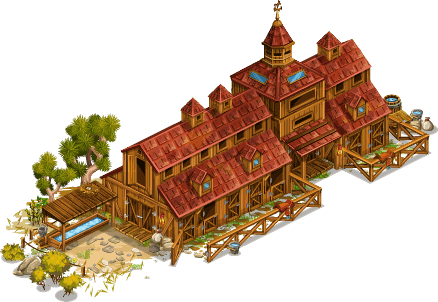
Besides ordinary feed there is also premium feed and super feed for chickens, pigs, cows, ducks, donkeys and goats. These feeds aren't made in the mill - you drop them straight into the matching animal building (chicken coop, pigsty, cowshed, duck coop, donkey stable or goat stable) and production starts immediately.
They come in handy mainly when you don't have time to wait for the mill queue to clear, or when you're running out of the basic raw material for the classic recipe.