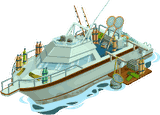
Fishing gear
Fishing gear in Big Farm comes in two separate sets - the boat crew with the add-ons for sea expeditions, and personal equipment with a rod, reel, line and lures for classic fishing aimed at specific fish. Every item has a clear purpose, from speeding up the voyage through protecting the boat from sharks, icebergs and storms all the way to picking the right lure for carp or sturgeon. I've written down what each category is for and how I'd rank them by priority.
It pays to build your gear up step by step according to what you're actually fishing for - first the personal rod and a lure for your target fish, and only then the boat crew and protection for longer and more dangerous trips out at sea.
Fishing gear splits into boat equipment and personal gear
Fishing equipment in Big Farm falls into two groups that you work with in completely different ways. The first group belongs to the boat and sea expeditions - crew members and add-ons that determine how many fish the boat lands per hour, how fast it sails to the fishing spot, how long the fishing takes, how well the boat is protected from danger and how much of the catch fits into storage. The second group is personal fishing gear - the rod, reel, line and lure, which I pick based on the particular fish I'm going after.
Both groups can be upgraded independently of each other. On a boat expedition it makes sense to complete the whole crew at once, while with personal gear I swap rods and lures around depending on my target - I take one combination for carp near the shore and a different one for tuna out on the open sea.
The boat crew decides your catch, sailing speed and fishing time
On a boat expedition I fill three different roles. The number of fish landed per hour is handled by crew members like James, Roy, Paul, Nancy or John - each of them has a different story behind them (James even lost an eye hunting a swordfish), but they all end up increasing your catch. Sailing speed, meaning how much time you shave off the trip to the chosen area, is down to the boat mechanics Joe, Jim, Carol, Ian and Bridgitte - Joe is a true master at this, supposedly squeezing 10 % more power out of every turbine. The third role, fishing duration, belongs to the crew around Russell, Gerald, Lisa, Victor and Walter.
I've learned not to focus on just one role - a shorter voyage means more time on the fishing grounds, but without crew boosting the catch per hour that saved time never gets used to the full.
Protective equipment shields the boat from sharks, storms and icebergs
The further the boat sails out to sea, the bigger the risk of running into something dangerous, and that's exactly what protective equipment is for. Sonar warns the crew about a shark attack in time, so you can react before any damage is done. Seasoned old salts who have sailed through drifting ice know how to spot the danger and steer safely around it. Against sea storms you have a crew hardened by years at sea, and against octopuses, oddly enough, bottles of ink do the trick - thanks to them the octopus mistakes the boat for one of its own relatives. A powerful turbine can also pull the boat out of the grip of dangerous whirlpools.
I'd deal with this equipment mainly before longer expeditions to more distant and riskier areas - on a short trip close to home I can manage without it.
Nets, cages and fishing tools on board decide what you catch
Besides the crew, the boat can also be fitted with specific fishing tools. The net is the most versatile one, it works best for herring and can be used anywhere from a small pond to the open sea, while the trawl net dragged behind the boat scoops up shrimp without much effort. For individual fish species there are specialized rods made purely for boat expeditions - one is built for swordfish, another for salmon, a graphite one for cod and the toughest version for big, strong fish like tuna. For seafood there's an oyster rake, a wooden lobster cage and a sieve for collecting mussels from great depths.
The catch from the whole expedition then has to go somewhere - from a small cooler box through a fridge and a premium thermo box to a freezer that can handle even those days when the fish are biting one after another. I'd choose the storage size according to the length of the expedition, not according to whatever I happen to have at hand.
A personal rod, reel and line form the basis of your gear on shore
For classic fishing away from the big boat I need a rod, a reel and a line. With rods I start with a wooden or bamboo one that handles basic trips, and as I gain experience I move on to a carbon rod recommended for deeper water, or to a fiberglass or high-tech rod for the most demanding anglers. I pick the reel according to my fishing style - from a simple one for beginners all the way to an electric reel that practically brings the fish in by itself, or premium reels that experienced anglers consider the very best in the business. I choose the line according to the surroundings and the strength of the fish - monofilament line suits fishing from the shore, fluorocarbon line works better in deeper and sea water, and both come in light, medium and heavy versions.
A basic set is perfectly enough to start with, and I only worry about the exact combination of rod, reel and line once I'm targeting a particular fish or location.
Lures, a bucket and a tackle box round out your expedition kit
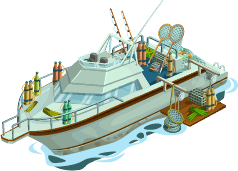
Universal hooks and lures like the Minnow or Shad work fine for everyday fishing, from the lighter version for beginners up to heavier professional lures. For a particular fish, such as carp, perch, catfish, sturgeon, pike, grouper, bluefish, goldfish, scorpionfish, mahi-mahi or skipjack tuna, there are always two lures - a basic one for a single fish and an advanced one that attracts several at once. On top of that I can use bait cooked from a specific ingredient, for example shrimp, oysters, mussels or herring - bait like that doesn't just draw in that one fish, but also other species higher up the food chain, so herring bait brings in lobsters, cod, salmon and swordfish as well.
The bucket is there to keep the catch until I get back to shore, and the tackle box holds the fishing gear itself - the bigger versions of both are made with longer trips in mind, and the tackle box even leaves room for a snack.