The economic cycle and production chains
A farm in Goodgame Big Farm is one connected system, not a pile of separate buildings - what I harvest in the fields often ends up as feed for my animals, and what the animals or orchards produce I either sell or use as an ingredient further down the line. The economic cycle is an actual in-game window that lays out all these relationships between products. On this page I describe how the individual production chains link up, what I need for what, and how to make production on the farm simpler.
The economic cycle isn't some extra fluff, it's the backbone of the whole farm - once you know which crops end up as feed and what you can add on top with hedgerow plants, you stop needlessly selling goods that you'll be scrambling to buy back at a high price a moment later.
The farm is a chain where both ingredients and finished goods keep being useful
The economic cycle is a window right there in the game that gives you an overview of where each product comes from and what they are all good for. I got into the habit of taking a look at it whenever I wasn't sure whether it pays off more to sell something straight away or hold on to it for production.
The basic principle is simple - I either sell each product in the farm management window, or I use it as an ingredient for producing another product. So field crops don't only end up on the market, they mainly end up at the mill, where they come back as feed for my animals, and only then do the outputs from animal buildings and orchards form the second layer of goods that I sell or process further.
The mill turns field crops into feed that matches each animal building
Every animal building needs its own specific feed to run, and that feed isn't made in the building itself but at the mill, out of field crops. The combinations are fixed and it pays off to know them before you sell your crops.
| Animal building | Feed is made from | Main product |
|---|---|---|
| Chicken coop | corn | eggs |
| Pigsty | cabbage | pigs |
| Cowshed | wheat | milk |
That's exactly why I make a habit of setting part of my corn, cabbage and wheat harvest aside instead of selling all of it - sooner or later I need it back as feed anyway.
Orchards and animal buildings need an ingredient to start, fields manage without one
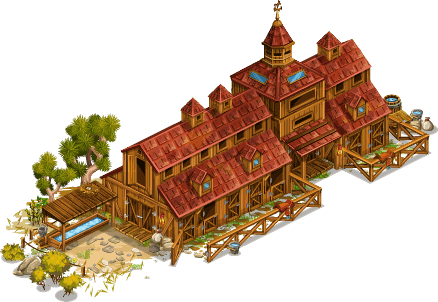
Orchards work much like animal buildings - I grow apples or cherries in them, and on the gourmet farm there's goat milk from the goat stable and almonds from the almond orchard on top of that. The difference compared to fields is that animal buildings and orchards always need some ingredient as input before production can even begin.
Growing crops in fields is more forgiving in this respect - it works even without humus, so early in the game I don't have to worry about whether I've got humus on hand. With animal buildings and orchards I don't have that option, so I keep an eye on my ingredients in advance, especially before I start production in several buildings at once.
Hedgerow plants within the Cooperative add by-products
Once normal production is running, you can add hedgerow plants to a field, garden or meadow, where they work as a bonus on top of the main production. The condition is membership in a Cooperative - without one, hedgerow plants can't be used.
Hedgerow plants also bring by-products of their own. As a general rule, when harvesting normal production I always have a certain chance of getting an extra item as a by-product, and that chance differs depending on the specific ingredient and the type of production - so with some crops or animal buildings it's worth watching what extras pop up at harvest.
The serial production manager can run production across the whole farm at once
Once I've got several buildings of the same type on the farm, starting production in each one by hand stops making sense. That's what the serial production manager is for - a tool that only works on the farm you're currently standing on, but starts production in all the selected buildings in one go.
- In the menu I switch between the categories seeds, animals and orchard crops, including buildings I haven't built yet.
- With the buttons I pick the exact number of idle buildings that will join in - all the production figures are recalculated according to how many I select.
- In the drop-down list I choose the ingredient for the next production run, such as seeds, humus or fertilizer, and buy any missing amount right there when I confirm.
- In the product detail I can see how long production takes and how much it yields.
The tool first has to be activated with one of four kinds of coupons with different durations, or permanently by buying a subscription in the shop - even without activating it, though, I can open it any time and just take a look around.
A finished product either gets sold or serves as an ingredient further on
I sell most products in the farm management window, but plenty of them are worth more as an ingredient for further production - crops for feed being the obvious example. Not every product carries on down the chain, though - with some of them selling on the market is the only option, because nothing else can be made from them.
The same goes the other way round - some items can't be produced on the farm at all and can only be picked up from events or shop offers. Before I start stockpiling an ingredient, I'd rather use the search in the production info dialog to check whether it actually helps me make what I need right now.